
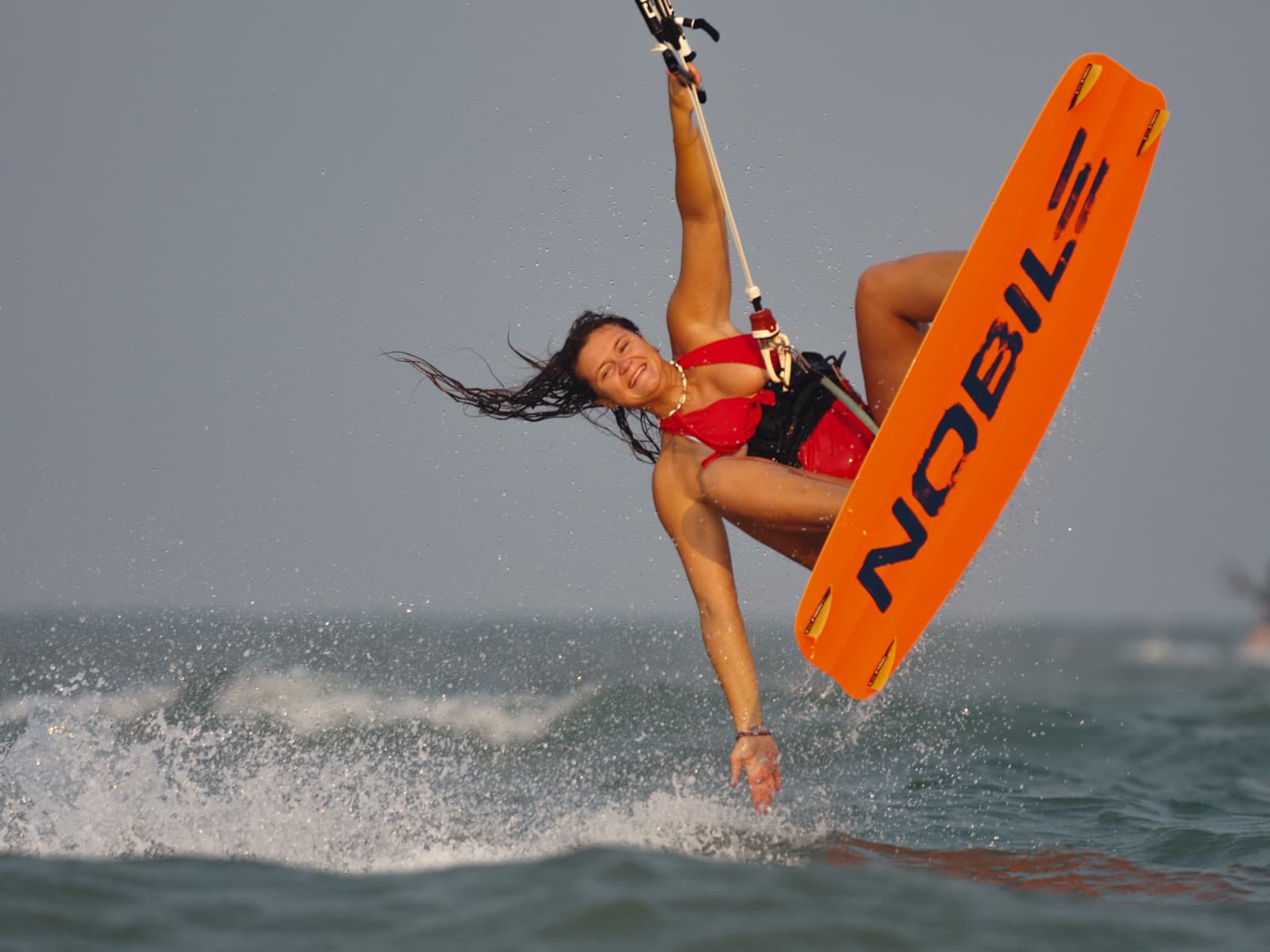
Грэбы (grabs) на кайте: как хватать доску в прыжкеGrabs in kiteboarding: how to grab the board mid-jump
Грэб (от англ. *grab* — «схватить») — это захват доски рукой в прыжке. Одна рука остаётся на планке и держит кайт, вторая тянется к доске и берётся за неё в определённом месте — и от того, где именно вы взялись и какой рукой, зависит название трюка.A grab is exactly what it sounds like: catching hold of the board with your hand while you're in the air. One hand stays on the bar and keeps the kite steady, the other reaches down and takes the board at a specific spot — and it's the hand and the spot that give each grab its name.
22 июня 202622 June 2026 · JollyKite
Зачем нужен грэбWhy grab at all
Грэб выглядит эффектно — но это не единственная и даже не главная причина его учить.A grab looks good — but that's not the only, or even the main, reason to learn it.
- Контроль тела в воздухе. Когда вы держите доску рукой, тело собирается в компактную позицию. Ноги перестают болтаться, корпус стабилизируется, прыжок становится читаемым и предсказуемым. Многие впервые понимают, что такое «контроль в воздухе», именно на грэбе.Body control in the air. With a hand on the board, your body pulls into a compact shape. Your legs stop dangling, your torso settles, and the jump becomes readable and predictable. Plenty of riders first understand what "control in the air" means through a grab.
- Стиль. Грэб — то, что отличает «просто прыгнул» от «прыгнул красиво». Это первый инструмент стиля, доступный сразу после базового прыжка.Style. The grab is what separates "I jumped" from "I jumped well." It's the first styling tool available right after the basic jump.
- База для будущих трюков. Грэбы вставляют внутрь вращений, борд-оффов, фристайл-трюков. Умение спокойно найти доску рукой в воздухе пригодится в каждом из них.A base for future tricks. Grabs go inside rotations, board-offs and freestyle tricks. Being able to calmly find the board with your hand pays off in every one of them.
- Судейство. В соревновательном кайтбординге грэб — часть оценки: судьи смотрят, насколько чисто вы взялись, насколько долго держали и насколько собранной была позиция. Даже если вы не собираетесь на соревнования, эти критерии — хороший ориентир качества.Judging. In competitive kiteboarding the grab is part of the score: judges look at how cleanly you took the board, how long you held it and how composed the position was. Even if you never compete, those criteria are a good yardstick for quality.
Что нужно уметь до грэбаWhat you need before the grab
Единственное предусловие — уверенный, стабильный прыжок с контролем приземления.The only prerequisite is a confident, stable jump with a controlled landing.
Это значит: вы прыгаете в обе стороны, отрыв получается предсказуемо, вы не думаете о том, куда девать кайт, и вы возвращаете его вперёд, приземляясь в движение, а не плашмя. Если прыжок ещё «случайный» — сначала докатайте его: подробный разбор в материале первый прыжок на кайте, а рост в высоту и мягкость — в статье как прыгать выше и мягче приземляться.That means: you jump both ways, the takeoff is predictable, you don't have to think about where the kite is, and you bring it forward to land into the motion rather than flat. If the jump is still hit-and-miss, finish it off first: see your first kitesurfing jump, and for height and softness, how to jump higher and land softer.
Причина простая. В грэбе вы снимаете одну руку с планки и на секунду перестаёте управлять кайтом двумя руками. Если прыжок нестабильный, эта секунда обойдётся вам жёстким приземлением. На стабильном прыжке у вас появляется свободное время в воздухе — и вот его-то и занимает грэб.The reason is simple. In a grab you take a hand off the bar and, for a second, stop steering the kite with both hands. On an unstable jump, that second costs you a hard landing. On a stable jump you have spare time in the air — and the grab is what fills it.
Высота при этом не главное. Грэб отлично получается на среднем прыжке — важнее не сколько вы висите, а насколько спокойно.Height isn't the point. A grab works perfectly well on a medium jump: what matters isn't how long you hang, but how calm you are while you do.
Главный принцип: доску тянут к себеThe core principle: pull the board to you
Почти все, кто впервые пробует грэб, делают одно и то же: тянутся к доске корпусом. Наклоняются, изгибаются, ловят рукой воздух — и приземляются криво.Almost everyone trying their first grab does the same thing: they reach for the board with their body. They bend, twist, grab at air — and land sideways.
Правильно наоборот. Доску подтягивают к себе коленями, а рука лишь встречает её на полпути.It works the other way round. You pull the board up to you with your knees, and the hand simply meets it halfway.
- Работают ноги, корпус спокоен. Подтяните колени к груди — доска сама придёт в зону, где рука до неё дотянется. Руке остаётся просто взяться, без всяких подвигов.The legs do the work, not the torso. Pull your knees toward your chest and the board comes into reach on its own. The hand's job is to take hold, not to perform a miracle.
- Корпус остаётся ровным. Не сгибайтесь пополам, не заваливайте плечи. Ровный корпус — это и стабильность в воздухе, и красивая позиция.Keep the torso upright. Don't fold in half, don't drop a shoulder. An upright body means stability in the air and a good-looking position.
- Кайт держат стабильно одной рукой. Вторая рука остаётся на планке — по центру, и кайт не двигают. Он просто стоит там, где вы его оставили после отправки.Hold the kite steady with one hand. The other hand stays on the bar, centred, and does not steer. The kite just sits where you left it after the send.
- Смотрят вперёд. Не на доску, не на руку. Взгляд — по направлению движения, туда, где вы приземлитесь. Опущенный взгляд сразу разворачивает корпус и ломает позицию.Look forward. Not at the board, not at your hand. Your eyes go in your direction of travel, to where you'll land. A dropped gaze twists your torso and ruins the position instantly.
Запомните формулу: колени вверх → рука вниз → взялся → отпустил → приземлился. Всё остальное — детали.The formula: knees up → hand down → grab → release → land. Everything else is detail.
Основные грэбы: где именно хватать доскуThe main grabs: where exactly to take the board
Название грэба определяется двумя вещами: какой рукой вы беретесь и за какое место доски. Разберём основные. «Передняя нога» — та, что ближе к носу доски по направлению движения; «задняя» — ближе к хвосту. Передняя и задняя руки — соответственно.A grab's name comes from two things: which hand you use and where on the board you take hold. Here are the main ones. Your "front foot" is the one closer to the nose in your direction of travel; the "back foot" is closer to the tail. Front and back hands, likewise.
- Indy. Задняя рука хватает доску за носковую грань между креплений, ближе к задней ноге. Самый естественный и самый первый грэб: доска сама приходит под руку, когда вы подтягиваете колени. Отсюда все и начинают.Indy. The back hand takes the board on the toe-side edge between the bindings, closer to the back foot. The most natural and the very first grab: the board comes right to your hand as you pull your knees up. Everyone starts here.
- Tail grab. Задняя рука берётся за хвост доски — за самый край позади задней ноги. Требует чуть больше подтянуть заднюю ногу. Второй по простоте.Tail grab. The back hand takes the tail of the board — the very end, behind the back foot. Needs slightly more back-knee lift. Second easiest.
- Nose grab. Передняя рука берётся за нос доски — за край перед передней ногой. Зеркальный tail: подтягиваете переднюю ногу и встречаете нос рукой.Nose grab. The front hand takes the nose of the board, in front of the front foot. The mirror of the tail: pull the front knee up and meet the nose with your hand.
- Stalefish. Задняя рука заходит за спину и берёт доску за пяточную грань между креплений. Позиция скрученная, но эффектная — рука проходит позади тела.Stalefish. The back hand reaches behind your back and takes the board on the heel-side edge between the bindings. A twisted but striking position — the arm passes behind the body.
- Melon. Передняя рука берётся за пяточную грань между креплений. Пожалуй, самый «читаемый» грэб после indy: рука идёт вниз и назад, доска встречает её.Melon. The front hand takes the heel-side edge between the bindings. Probably the most readable grab after indy: the hand goes down and back, and the board meets it.
- Mute. Передняя рука хватает за носковую грань между креплений — то есть тянется через тело, к дальней от неё грани. Отсюда сложность: нужна собранная поза и скрутка.Mute. The front hand takes the toe-side edge between the bindings — reaching across the body to the far edge. Hence the difficulty: you need a compact stance and a bit of twist.
- Slob. Передняя рука берётся за носковую грань перед передней ногой — ближе к носу, чем в mute. Тот же принцип, другая точка.Slob. The front hand takes the toe-side edge in front of the front foot — closer to the nose than in a mute. Same principle, different point.
- Seatbelt (roast beef). Экзотика. В seatbelt задняя рука тянется через тело и берёт доску за носковую грань перед передней ногой — рука ложится наискосок, как ремень безопасности, отсюда название. В roast beef рука проходит между ног и берётся за пяточную грань. Оба требуют серьёзной гибкости и полного контроля прыжка — это уже не про первые грэбы.Seatbelt (roast beef). Exotic territory. In a seatbelt, the back hand reaches across the body and takes the board on the toe-side edge in front of the front foot — the arm lies diagonally, like a seatbelt, hence the name. In a roast beef, the hand goes between the legs to the heel-side edge. Both need real flexibility and full control of the jump — this isn't first-grab material.
Не старайтесь запомнить всё сразу. На воде толку больше от двух-трёх грэбов, которые выходят чисто, чем от списка в десять штук, которые получаются «примерно».Don't try to memorise them all. On the water you want two or three grabs you do cleanly, not a list of ten you do "roughly."
В каком порядке учитьThe order to learn them in
Порядок обычно такой — от того, что доска сама подставляет под руку, к тому, за чем надо тянуться через тело:The usual progression runs from what the board hands you to what you have to reach across your body for:
- Indy — база. Задняя рука, доска приходит сама.Indy — the base. Back hand, board comes to you.
- Tail — тот же принцип, точка захвата дальше к хвосту.Tail — same principle, grip point further back.
- Melon / stalefish — переход на пяточную грань, появляется работа корпусом.Melon / stalefish — moving to the heel edge, with more body involvement.
- Mute — рука идёт через тело, нужна собранная поза.Mute — the hand crosses the body; you need a compact stance.
- Nose, slob — переднерукие варианты с другими точками.Nose, slob — front-hand variants at other points.
- Seatbelt, roast beef и прочая экзотика — когда прыжок и позиция в воздухе полностью под контролем.Seatbelt, roast beef and the rest of the exotics — once the jump and your air position are fully under control.
Каждый грэб отрабатывайте в обе стороны. Кайтсёрфинг быстро делает из вас человека с одной «удобной» стороной, и на трюках это вылезает сразу.Practise each grab both ways. Kiteboarding turns you into a one-sided rider fast, and on tricks that shows up immediately.
Частые ошибкиCommon mistakes
- Ранняя попытка. Грэб на нестабильном прыжке — это грэб, который заканчивается плохим приземлением. Сначала прыжок, потом стиль.Trying too early. A grab on an unstable jump is a grab that ends in a bad landing. Jump first, style second.
- Тянутся к доске корпусом. Самая распространённая ошибка. Наклон ломает позицию, разворачивает плечи и утаскивает вас в сторону. Доску подтягивают коленями.Reaching for the board with your body. The most common error by far. Bending breaks the position, twists your shoulders and pulls you off line. Pull the board up with your knees.
- Роняют кайт. Сняли руку с планки — и вторая рука невольно потянула планку в сторону. Кайт уходит, тяга меняется, приземление становится сюрпризом. Оставшаяся рука держит планку по центру и не рулит.Dropping the kite. You take one hand off the bar and the other unconsciously pulls it sideways. The kite moves, the pull changes, and the landing turns into a surprise. The remaining hand holds the bar centred and doesn't steer.
- Забывают про приземление. Увлеклись захватом — и не вернули кайт вперёд. Про возврат кайта не забываем никогда: это то, что делает приземление мягким.Forgetting the landing. You get absorbed in the grab and never bring the kite forward. Never skip that: it's what makes the landing soft.
- Держат слишком долго. Грэб должен быть коротким и чётким. Отпускайте доску заранее, чтобы успеть поставить ноги, вернуть кайт и приземлиться нормально. Держать до последнего — верный способ приземлиться плашмя.Holding too long. A grab should be short and crisp. Let the board go early enough to set your feet, bring the kite forward and land properly. Hanging on to the last moment is a reliable way to land flat.
- Смотрят на доску. Опустили взгляд — потеряли баланс. Смотрите вперёд, а доску подводите коленями: искать её глазами не нужно.Looking at the board. Eyes down means balance gone. Look forward, and find the board with your knees, not your eyes.
Что дальшеWhat's next
Чистый грэб в обе стороны — это уже уверенный контроль тела в воздухе, и дальше открываются две дороги.A clean grab both ways means you already control your body in the air, and two roads open up.
Первая — вращения: бэкролл и фронтролл, а затем вращение 360°. Вторая — снятие доски в воздухе: борд-офф, где умение спокойно найти доску рукой окажется прямо кстати.The first is rotations: backroll and frontroll, then the 360. The second is taking the board off in the air: board-off, where being able to calmly find the board with your hand comes in very handy.
Параллельно стоит осваивать поп (pop) — отрыв за счёт канта, без посыла кайта вверх. Это отдельная ветка прогресса и фундамент всего фристайла: именно с попа начинаются отстёгнутые трюки. Всю карту прогресса — что за чем — смотрите в Школе трюков JollyKite.In parallel, it's worth learning the pop — the takeoff off the edge, without sending the kite up. That's a separate branch of progression and the foundation of all freestyle: unhooked tricks start from the pop. For the full map of what comes after what, see the JollyKite Trick School.
Если грэб не идёт, почти всегда виноват прыжок: он ещё не стал автоматическим. Вернитесь к материалам первый прыжок на кайте и как прыгать выше и мягче приземляться, доведите прыжок до спокойного и повторяемого — и грэб приложится.If the grab isn't happening, the jump is almost always to blame — it hasn't become automatic yet. Go back to your first kitesurfing jump and how to jump higher and land softer, get the jump calm and repeatable, and the grab will follow.
Кстати, на грэбах внезапно становится важна доска: слишком большая и тяжёлая тянет ноги вниз и мешает собраться в воздухе. Об этом — в материале как выбрать кайтборд.One more thing: on grabs, the board suddenly matters. A board that's too big and heavy drags your legs down and stops you compacting in the air. More on that in how to choose a kiteboard.
Трюки мы ставим под контролем инструктора, с радиосвязью на воде и на просторной воде Пак Нам Прана — инструктор видит вашу позицию со стороны, а в грэбе именно позиция решает всё. Подробнее о форматах и записи — на странице /obuchenie. Как мы строим прогресс — в методике обучения JollyKite.We teach tricks under an instructor's supervision, with radio comms on the water, in the open water of Pak Nam Pran — the instructor sees your position from the outside, and in a grab the position is everything. More on formats and booking on the /obuchenie page. How we build progression: the JollyKite teaching method.
Поедем кататься?Let's go riding?
Напишите нам даты и уровень — подскажем формат, подберём сезон под ваш ритм и посчитаем поездку под ключ. WhatsApp +66 98 367 9769, Telegram-бот @JollyKite_kite_bot.Send us your dates and level — we'll suggest a format, match the season to your rhythm and plan your trip end to end. WhatsApp +66 98 367 9769, Telegram bot @JollyKite_kite_bot.
Частые вопросыFAQ
Что такое грэб (grab) в кайтсёрфинге?What is a grab in kiteboarding?+
Грэб — это захват доски рукой в прыжке. Одна рука остаётся на планке и держит кайт, вторая берётся за доску в определённом месте. От того, какой рукой и за какую часть доски вы взялись, зависит название трюка: indy, tail, nose, melon, stalefish, mute и другие.A grab is catching hold of the board with your hand during a jump. One hand stays on the bar holding the kite steady, the other takes the board at a specific point. The name of the trick depends on which hand you use and which part of the board you take: indy, tail, nose, melon, stalefish, mute and others.
Что нужно уметь до грэба?What do you need before learning grabs?+
Единственное предусловие — уверенный стабильный прыжок в обе стороны с контролем приземления. Вы должны спокойно отрываться от воды, не думать о том, куда девать кайт, и возвращать его вперёд перед приземлением. На нестабильном прыжке снимать руку с планки рано.The only prerequisite is a confident, stable jump both ways with a controlled landing. You should leave the water predictably, not have to think about where the kite is, and bring it forward before landing. On an unstable jump it's too early to take a hand off the bar.
Как правильно хватать доску в прыжке?How do you grab the board properly?+
Доску подтягивают к себе коленями, а не тянутся к ней корпусом. Подтяните колени к груди — доска сама придёт под руку, и останется только взяться. Корпус держите ровным, кайт — стабильно одной рукой на планке, взгляд направляйте вперёд, а не на доску.You pull the board up to you with your knees rather than reaching for it with your body. Pull your knees toward your chest and the board comes into reach on its own — all that's left is to take hold. Keep your torso upright, hold the kite steady with one hand on the bar, and look forward, not at the board.
Какой грэб учить первым?Which grab should you learn first?+
Обычно начинают с indy: задняя рука хватает доску за носковую грань между креплений. Это самый естественный захват — доска сама приходит под руку, когда вы подтягиваете колени. Дальше идут tail, затем melon и stalefish, потом mute, и только потом экзотические варианты вроде seatbelt.Usually the indy: the back hand takes the board on the toe-side edge between the bindings. It's the most natural grip — the board comes right to your hand as you pull your knees up. Then comes the tail, then melon and stalefish, then mute, and only after that the exotic ones like seatbelt.
Чем отличаются indy, tail и melon?What's the difference between indy, tail and melon?+
Разница в руке и точке захвата. Indy — задняя рука за носковую грань между креплений. Tail — задняя рука за хвост доски, позади задней ноги. Melon — передняя рука за пяточную грань между креплений. Одно и то же движение коленей, разные точки, за которые встречает рука.The hand and the grip point. Indy — back hand, toe-side edge between the bindings. Tail — back hand, the tail of the board behind the back foot. Melon — front hand, heel-side edge between the bindings. Same knee movement, different points where the hand meets the board.
Нужен ли для грэба высокий прыжок?Do you need a big jump to grab?+
Нет. Грэб хорошо получается и на среднем прыжке — важна не высота, а спокойствие и стабильность в воздухе. Если вы отрываетесь предсказуемо и контролируете приземление, свободного времени в воздухе хватит на чистый захват.No. A grab works fine on a medium jump — what matters is calm and stability in the air, not height. If your takeoff is predictable and your landing controlled, you'll have enough time up there for a clean grab.
Почему я не могу дотянуться до доски?Why can't I reach the board?+
Скорее всего, вы тянетесь к доске корпусом вместо того, чтобы подтягивать её коленями. Наклон ломает позицию и всё равно не даёт дотянуться. Подтяните ноги к себе, оставьте корпус ровным — и рука встретит доску без усилия.Most likely you're reaching for the board with your body instead of pulling it up with your knees. Bending breaks your position and still doesn't get you there. Pull your legs up, keep the torso upright — and your hand will meet the board effortlessly.
Поедем кататься?Shall we go riding?
Напишите даты и уровень — посчитаем поездку под ключ и подберём формат.Tell us your dates and level — we’ll plan the whole trip.